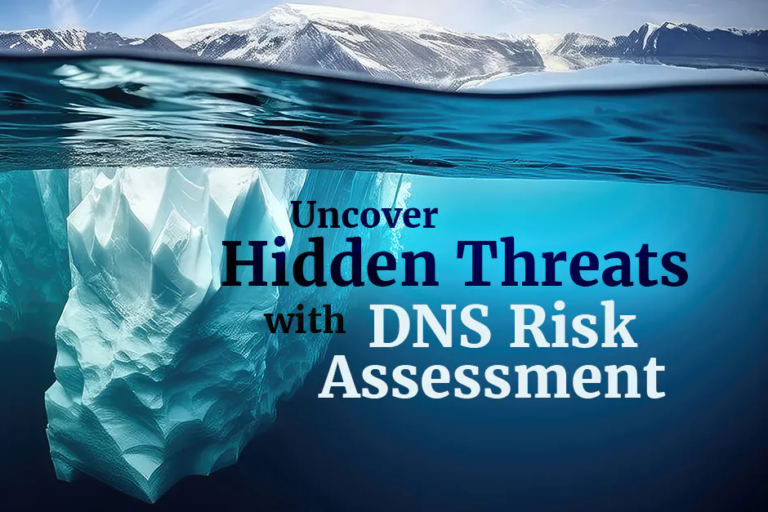
A DNS Risk Assessment uncovers hidden threats, misconfigurations, blind spots, and compliance risks buried deep inside your DNS traffic.
By analyzing real queries with AI-powered intelligence, it reveals what many organizations consistently miss.
Even with multiple security tools in place, a surprising amount of suspicious DNS activity goes unnoticed. A DNS Risk Assessment exposes what lurks underneath: malicious domains, tunneling behavior, certificate issues, misconfigurations, shadow IT, risky applications, and other hidden risks buried deep within DNS traffic. The deepest risks in your network rarely announce themselves – but DNS always leaves a trail.

A DNS Risk Assessment That Changed Everything
During a recent DNS Risk Assessment, a customer submitted just one day of DNS traffic for analysis. The report quickly surfaced several findings they hadn’t been aware of at all: DNS queries linked to phishing and malware domains, multiple certificate weaknesses — and one pattern in particular that stood out. A series of unusually long, repetitive subdomain queries appeared during off-hours, a classic early indicator of DNS tunneling. While small in volume, this type of activity is often used to test whether data can be pushed out unnoticed, and it wasn’t something the customer had ever seen before. It was a clear reminder that DNS often reveals the earliest signs of risk long before they appear anywhere else.
This customer is not alone. A 2025 Forrester Study found that 95% of organizations experienced DNS-related attacks or vulnerabilities in the past year, with phishing and malware among the most common threats observed at the DNS layer. DNS tunneling, the technique hinted at in this customer’s assessment, has been reported by 26% of organizations, suggesting that the off-hours, long-subdomain activity uncovered in this customer’s network reflects a broader attacker behavior. In response, 85% of security leaders consider regular DNS audits critical, and 91% are prioritizing stronger DNS monitoring and analysis, highlighting the growing importance of DNS Risk Assessments as a first step in understanding and reducing exposure.
How EfficientIP DNS Risk Assessment Works
One of the most valuable aspects of our DNS Risk Assessment is how simple and non-intrusive it is. The process starts with capturing real DNS traffic, typically a standard tcpdump from one of your DNS resolvers or forwarders. There is no installation, no agent, and no disruption to your production environment. Once the capture is securely uploaded, the assessment tool processes the data and generates a clear, interactive report tailored to your organization.
Behind the scenes, the analysis uses EfficientIP’s global DNS Threat Intelligence, machine learning models, statistical techniques, and passive DNS data. It correlates patterns across billions of DNS records to identify unusual behavior, suspicious domains, and signals that may indicate misconfigurations or security risks.
An EfficientIP expert then reviews the findings to ensure accuracy, highlight what matters most, and guide you through the results. This context helps validate what is normal in your environment and points directly to areas that need attention.The outcome is clear, evidence-based visibility. You see exactly what happened inside your DNS traffic, which devices and IP addresses were involved, which IOCs were triggered, where anomalies or risks may exist and the overall risk score. Because the report is structured into clear sections with explanations and visualizations, teams can easily understand the findings and prioritize the next steps.
Read more about how the this works at the Efficient IP Risk Assessment web page. It’s free and offers immediate insight to what is at risk inside your environment.
Read more about EfficientIP at TDS
Also links to other relevant articles: